

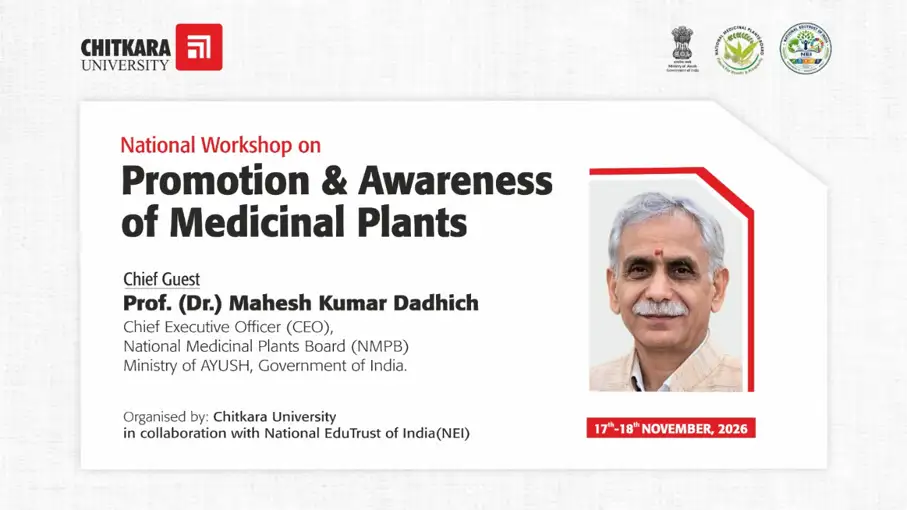
Chitkara University, Punjab, hosted a two-day National Workshop on Promotion and Awareness of Medicinal Plants on November 17–18, 2026. Sponsored by the National Medicinal Plants Board (NMPB), Ministry of AYUSH, Government of India, and organised by the National EduTrust of India (NEI), the initiative aimed to strengthen awareness about India’s rich medicinal plant heritage and promote its conservation, sustainable utilisation and ecological significance and to also provide training on preparing seed balls.
The workshop sought to highlight the importance of medicinal plants in traditional healthcare systems, ecological sustainability and biodiversity conservation, while encouraging informed participation in protecting and preserving these valuable natural resources.
The national-level workshop was graced by the presence of Dr. Madhu Chitkara, President and Co-Founder, Chitkara University, whose continued commitment to education, sustainability and institutional development reflected the University’s dedication to meaningful academic and environmental initiatives. The workshop was organised under the patronage of Dr. Ashok K. Chitkara, Chancellor, Chitkara University, and Dr. Madhu Chitkara, President & Co-Founder, Chitkara University.
The inaugural ceremony was graced by Prof. (Dr.) Mahesh Kumar Dadhich, Chief Executive Officer, National Medicinal Plants Board, Ministry of AYUSH, Government of India, as the Chief Guest. The distinguished Guests of Honour include Prof. Sayeed Ahmad, Professor and Director, Centre of Excellence in Unani Medicine, Jamia Hamdard, New Delhi; Prof. (Dr.) Sanjay Jachak, Professor and Head, Department of Natural Products, National Institute of Pharmaceutical Education and Research (NIPER), Mohali; and Mr. Samarth Sharma, CEO, National EduTrust of India.
The inaugural proceedings featured a ceremonial lamp-lighting ceremony, addresses by distinguished dignitaries and the launch of the “One Student, One Medicinal Plant” campaign. The campaign aims to inspire students to take an active role in environmental conservation by encouraging individual responsibility towards the preservation and cultivation of medicinal plants.
The inaugural address was delivered by Prof. (Dr.) Mahesh Kumar Dadhich, CEO, National Medicinal Plants Board, Ministry of AYUSH, who graced the occasion as the Chief Guest. In his insightful address, he emphasized the significance of integrating medicinal plants into everyday life and highlighted their potential in promoting holistic health and well-being. He encouraged participants to cultivate medicinal plants in their home gardens, specifically recommending Tulsi, Giloy, Pippali, Aloe vera, and Snake Plant, to foster awareness about their therapeutic value and encourage the adoption of traditional herbal practices in daily living.
The presence of eminent dignitaries, national-level experts and academic leaders lends significance to the occasion, providing an important platform for meaningful dialogue and collaborative efforts towards the promotion and preservation of medicinal plant diversity. The programme also included the ceremonial plantation of five medicinal plant species at the University’s Herbal Garden, symbolising Chitkara University’s commitment to biodiversity conservation and sustainable environmental practices.
The workshop provided a national platform for distinguished experts, academicians, researchers, students and institutional representatives to exchange knowledge, share perspectives and deliberate on strategies for the conservation and promotion of medicinal plant resources. A significant focus is placed on experiential learning, knowledge dissemination and practical engagement. Through expert-led sessions and demonstrations, participants will gain insights into the identification, cultivation, conservation and therapeutic applications of medicinal plants, particularly within India’s traditional AYUSH healthcare systems.
The deliberations further highlighted the importance of safeguarding indigenous medicinal plant species, preserving traditional botanical knowledge and promoting sustainable practices for the protection of biodiversity.
The second day of the workshop focused on practical environmental activities, including hands-on seed-ball preparation, outdoor preparation and sorting exercises, team formation, and the distribution and dispersal of seed balls. This activity was intended to familiarise participants with practical approaches to natural regeneration, ecological restoration and community-led environmental conservation. Mr. Hamid Raza, Senior Horticulturist, Chitkara University, Punjab, is serving as the Resource Person for the seed-ball preparation demonstration. As a key outcome of this workshop, approximately 1,000 medicinal plant seed balls were prepared. These will now be dispersed across various locations in Punjab, with the aim of promoting herbal biodiversity, encouraging the conservation of medicinal plant species, and strengthening ecological sustainability.
The workshop featured expert sessions and demonstrations on the identification, cultivation, conservation and therapeutic applications of medicinal plants, with a focus on India’s traditional AYUSH systems and the preservation of indigenous botanical knowledge. Approximately 300 students actively participated offline in the event. Additionally, students and participants from 115 colleges and universities joined the workshop virtually, reflecting widespread academic interest and enthusiasm for the promotion and conservation of medicinal plants.
The workshop was convened by Sqn Ldr (Dr.) Rina Angel (V), Vice President, Infrastructure Enhancement and Chairperson, Centre of Excellence for Sustainability, Chitkara University, and Prof. (Dr.) Thakur Gurjeet Singh, Dean, Chitkara College of Pharmacy, Chitkara University, Punjab.
Through this national initiative, Chitkara University reaffirms its commitment to integrating academic knowledge, traditional wisdom and practical environmental action. The workshop is expected to encourage participating students and institutions to establish medicinal plant gardens, promote the cultivation of indigenous species and undertake sustained, student-driven initiatives in biodiversity conservation and environmental protection.
By bringing together distinguished national-level experts, institutional leaders, academic professionals and the student community, the workshop underscores the importance of collective responsibility in preserving India’s invaluable medicinal plant heritage while nurturing a culture of environmental awareness, sustainable development and ecological stewardship.
The workshop is held in hybrid mode, with other colleges attending online. Day 1 includes the inaugural ceremony, felicitation, group photograph, ceremonial plantation, expert addresses on medicinal plants and an expert demonstration on how to make seed balls. Day 2 concludes with closing remarks, a vote of thanks and certificate distribution.
https://lnkd.in/p/gnM38FMn
https://lnkd.in/p/dpPeWjaj
instagram.com/reel/DfwE3N0yAkh/?dlrf=MWRwaWR6ZDc4NTFlaw==